Patterns
Patterns
As we now know waves together form swing patterns. Swing pattern, also called wave patterns,
helps in understanding direction and potential of the direction. Being repetitive in nature, it gives a
clearer vision of what to expect next based on which a trader can plan a high probability trade set
up.
To learn swing patterns, zoom out the charts to see wave patterns clearly. Analyze as many wave
patterns to trade them.
We have already mentioned the pattern of a trend, uptrend and downtrend and also about Motive
wave Rules and Guidelines in the last lessons. Here we will talk about some of the Corrective
Patterns. Corrective pattern is always preceded by a Motive (Impulse or Diagonal) waves
about which we learnt in our last lesson about wave pattern.
Some common swing patterns
Continuation patterns
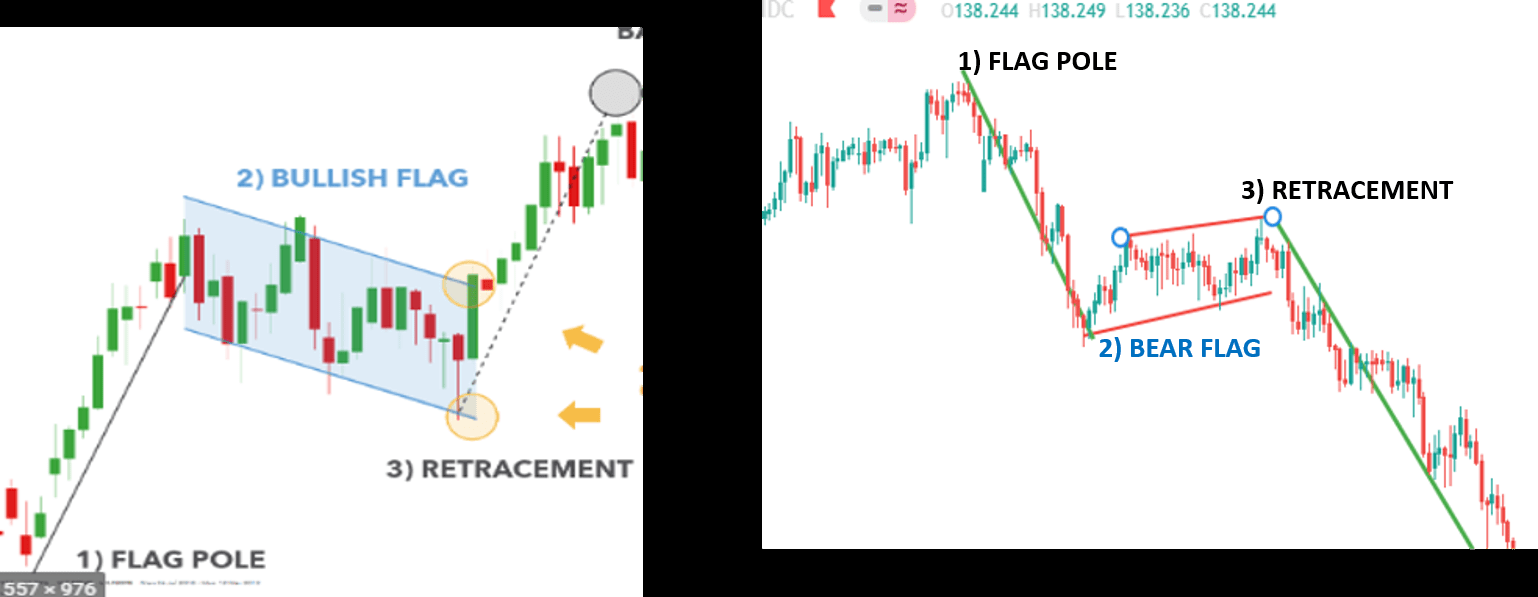
Bull flag, a bullish continuation pattern: a descending channel having down trending swings. at
the breakup of the flag channel, resumption of the uptrend can be expected. Bear flag is inverse of
bull flag and is a bearish continuation pattern.
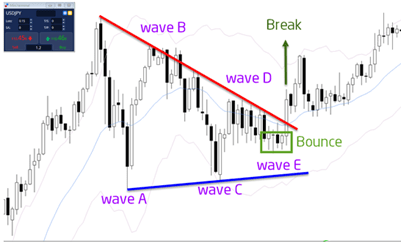
Contracting triangle – a 5 wave pattern ABCDE, with high low, lower high, higher low, lower
high and up. Upon the wave E completion, resumption of the trend is expected.
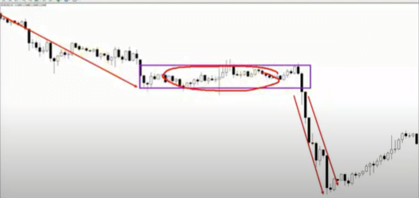
Sideways range
Horizontally ranging after an impulse. Expect a break out of the range in the direction of the trend.
There could be false breaks also so use lower time frame for a break preceded by a lower high in
case of a down trend.
Reversal patterns
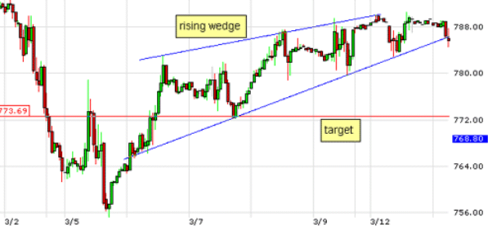
Wedge: a rising wedge comes in form of high, low, higher high, higher low, higher high but does
not form a parallel channel rather a contracting one, more flattened on the up side.
Falling wedge come in form of low, high, lower high, lower low, flattened on the down side if
coming after a down trend.
Wedges indicated exhaustion in the trend by loss of momentum. it is often accompanied by
divergence with the oscillator. It indicates potential reversal of a trend. Below is a rising wedge
after an impulse move up.
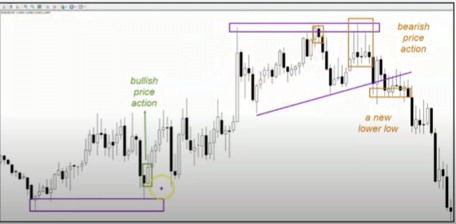
Double bottoms/Tops or Triple bottoms/tops: after an uptrend move, if you see two or three
swing highs forming at the same level, it is a double top or triple top pattern and is a trend
exhaustion signal to expect trend to reverse or go for bigger pull back.
Other than swing patterns, there are candlestick patterns which are mainly used for entry or trigger
signal. candlestick patterns are covered under candles (hyperlink).
In our next lesson we will learn Corrective Patterns as per Elliott wave theory which are more
interesting and makes it easy to analyze corrective pattern after an impulse to take position to trade
the next impulse.
Images
Comments (0)
- No comments yet.