Wave Patterns with Motive Wave Rules and Guidelines
Wave Pattern
• Swings are called waves when the swing legs are labeled by numbers or letters. Waves are
the constituting part of market structure and analyzing waves helps to know the next
swing/wave. More than 3 waves together form a pattern. Market is repetitive in nature and
by now we know it moves in swings/waves, fractals are swings of different degrees, these
waves form patterns on and these patterns keep repeating in different degrees.
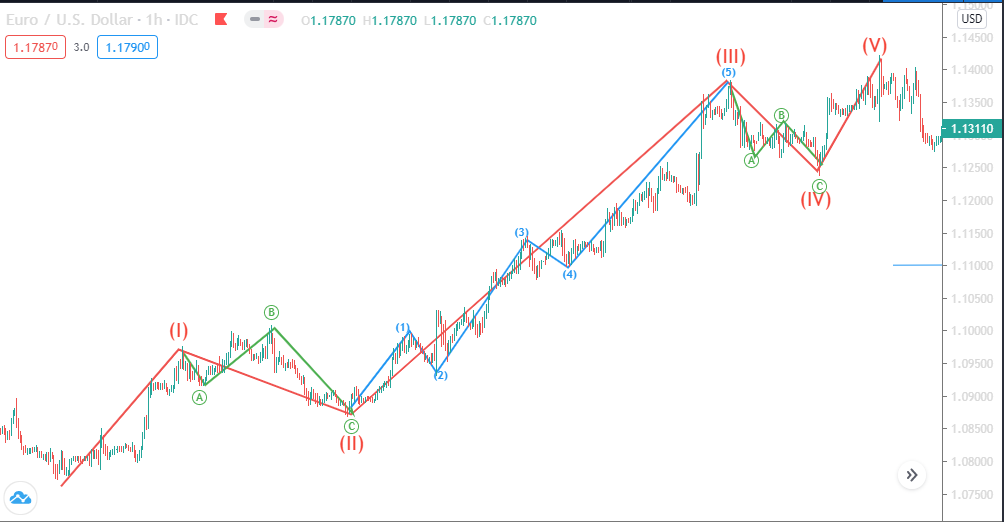
• As shown in picture below the red labeled waves 12345 are of the biggest degree in the
chart and shows an impulsive move having a sequence of higher highs and higher lows
(uptrend) hence forming an impulsive pattern. The green ones are smaller degree waves
labeled abc and are corrective patterns of the red impulse pattern. Another smaller degree
impulse is the blue 12345 patterns.
• So, the repetitive pattern of market chart is: impulse correction impulse. Wave 1, A, 3 and
5 are impulse waves and wave 2, B and 4 are corrective waves.
Combination of impulsive and corrective patterns either form a bigger degree correction or trend.
The next lesson tells you how to identify trend and its importance for a trader.
Wave Principal – Elliott Wave Theory
• Elliott Wave Theory is named after Ralph Nelson Elliott (28 July 1871 – 15 January 1948).
He was an American accountant and author. Inspired by the Dow Theory and by
observations found throughout nature, Elliott concluded that the movement of the stock
market could be predicted by observing and identifying a repetitive pattern of waves.
• Elliott was able to analyze markets in greater depth, identifying the specific characteristics
of wave patterns and making detailed market predictions based on the patterns. Elliott
based part his work on the Dow Theory, which also defines price movement in terms of
waves, but Elliott discovered the fractal nature of market action. Elliott first published his
theory of the market patterns in the book titled The Wave Principle in 1938.
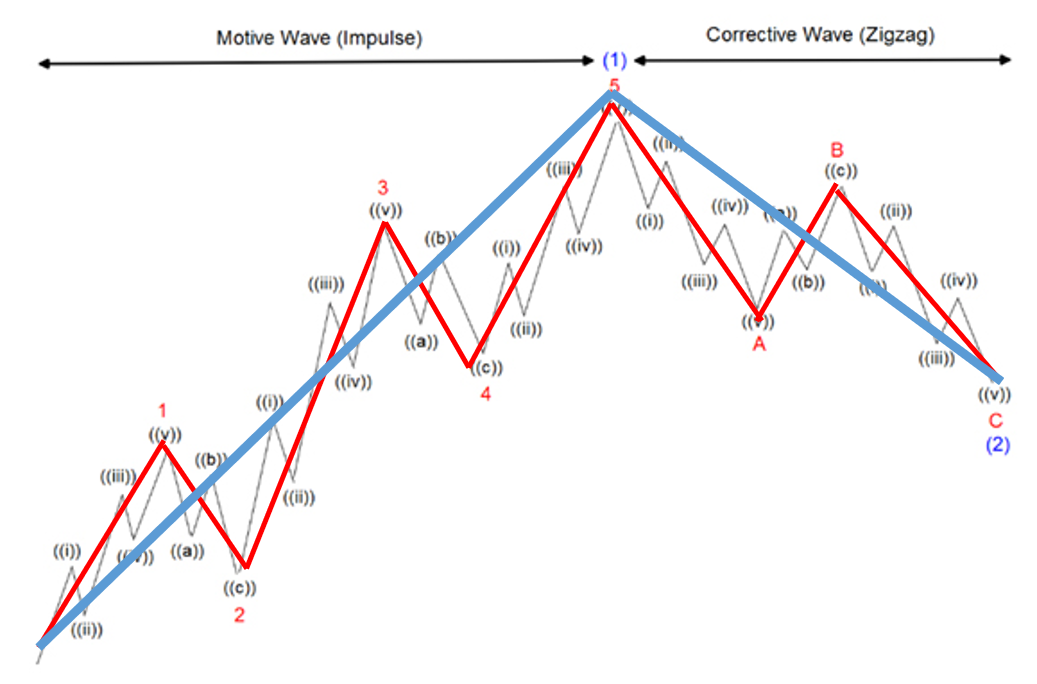
In Figure here, wave 1, 3 and 5 are motive waves and they are subdivided into 5 smaller degree
impulses labelled as ((i)), ((ii)), ((iii)), ((iv)), and ((v)).
Wave 2 and 4 are corrective waves and they are subdivided into 3 smaller degree waves
labelled as ((a)), ((b)), and ((c)). The 5 waves move in wave 1, 2, 3, 4, and 5 make up a larger
degree motive wave (1)
Rules of Impulse (Motive) Wave
1. An impulse wave subdivides into 5 waves. In Figure 2, the impulse move is subdivided as
1, 2, 3, 4, 5 in minor degree.
2. Wave 1 always subdivides into an impulse or (rarely) a diagonal.
3. Wave 3 always subdivides into an impulse. (Wave 1, 3, and 5 subdivision are impulse. The
subdivision in this case is ((i)), ((ii)), ((iii)), ((iv)), and ((v)) in minute degree)
4. Wave 5 always subdivides into an impulse or a diagonal.
5. Wave 2 always subdivides into a zigzag, flat or combination
6. Wave 2 never moves beyond the beginning of wave 1.
7. Wave 3 can not be the shortest wave of the three impulse waves, namely wave 1, 3, and 5
8. Never are waves 1, 3, and 5 all extended.
9. Wave 4 does not overlap with the price territory of wave 1
10. Wave 3 always moves beyond the end of wave 1
Wave 5 needs to end with momentum divergence
(1)
(3)
(2)
(4)
(5)
Guidelines for Impulse wave
1. Wave 4 will almost always be a different corrective pattern than wave 2
2. Wave 2 is usually a zigzag or zigzag combination
3. Wave 4 is usually a flat, triangle or flat combination.
4. Sometimes wave 5 does not move beyond the end of wave 3 (in which case it is called a
truncation)
5. Wave 5 often ends when meeting or slightly exceeding a line drawn from the end of wave
that is parallel to the line connecting the ends of waves 2 and 4, on either arithmetic or semi
log scale.
6. The center of wave 3 almost always has the steepest slope of any equal period within the
parent impulse except that sometimes an early portion of wave 1 will be steeper.
7. Wave 1, 3 or 5 is usually extended (extensions appear “stretched” because its corrective
waves are small compared to its impulse waves. It is substantially longer, and contains
larger sub divisions, than the non- extended waves).
8. Often, the extended sub wave is the same number (1, 3, 5) as the parent wave
9. Rarely do two sub waves extend, although its typical for waves 3 and 5 both to extend
when they are of Cycle or Supercycle degree and within a fifth wave of one degree higher.
10. Wave 1 is the least commonly extended wave.
11. When wave 3 is extended, waves 1 and 5 tend to have gains related by equality or the
Fibonacci ratio.
12. When wave 5 is extended, it is often in Fibonacci proportion to the net travel of waves 3
through 5.
13. Wave 4 typically ends when it is within the price range of subwave four of 3
14. Wave 4 often subdivides the entire impulse into Fibonacci proportion in time and / or price.
Rules of Diagonal (Motive) wave
1. A diagonal always subdivides into five waves.
2. An Ending Diagonal always appears as wave 5 of an impulse or wave C of zigzag or flat.
3. A leading diagonal always appears as wave 1 of an impulse or wave A of zigzag.
4. Waves 1, 2, 3, 4 and 5 of ending diagonal, and waves 2 and 4 of a Leading Diagonal,
always subdivide into zigzags.
5. Wave 2 never goes beyond the start of wave 1.
6. Wave 3 always goes beyond the end of wave1.
7. Wave 4 never moves beyond the end of wave 2.
8. Each of the waves : 1, 2, 3, 4, 5 are constituted with 3 sub waves.
9. Wave 4 always ends within the price territory of wave 1.
10. Going forward intime, a line connecting the ends of waves 2 and 4 converges towards 9in
the contracting variety) or diverges from (in the expanding variety) a line connecting the
ends of waves 1 and 3.
11. In a leading diagonal, wave 5 always ends beyond the end of wave 3.
12. In the expanding variety, wave 3 is always longer than wave 1, wave 4 is always longer
than wave 2, and wave 5 is always longer than wave 3.
13. In the expanding variety, wave 5 always ends beyond the end of wave 3.
(1)
(3)
(2)
(4)
(5)
Ending
Diagonal
(1)
(3)
(2)
(4)
Leading
Diagonal
Guidelines of Diagonal
1. Wave 2 and 4 each usually retrace .66 to .81 of the preceding wave.
Waves 1, 3 and 5 of a leading diagonal usually subdivide into zigzags but sometimes appear to be
impulses.
2. Within an impulse, if wave 1 is a diagonal, wave 3 is likely to be extended.
3. Within an impulse, wave 5 is unlikely to be diagonal if wave 3 is not extended.
4. In the contracting variety, wave 5 usually ends beyond the end of wave 3. (Failure to do so is
called a truncation)
5. In the contracting variety, wave 5 usually ends at or slightly beyond a line that connects the ends
of waves 1 and 3. (Ending beyond that line is called a throw-over).
6. In the expanding variety, wave 5 usually ends slightly before reaching a line that connects the
ends of waves 1 and 3.
Images
Comments (0)
- No comments yet.