Common mistakes and traps
Every idea in this module up to now has been introduced as if it were being applied correctly. This lesson looks at the same ideas from the other direction: the specific, recurring ways wave analysis goes wrong in practice, most of which come from a handful of predictable psychological shortcuts rather than from not knowing the rules.
Forcing a count to fit a conclusion you already reached
The single most common trap is deciding, consciously or not, what you want the chart to be doing — usually because of a position already held, or a prior bias about a symbol — and then reading the wave count that best supports that conclusion, rather than the wave count the price action actually supports. This rarely looks like a lie to the person doing it. It looks like generously interpreting an ambiguous swing as a "clean five" when a less invested observer would call it an obvious three, or quietly treating a broken rule as a rare exception because the alternative label is unwelcome.
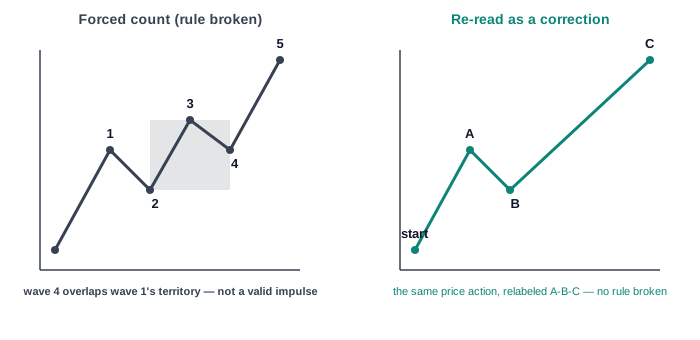
The defense against this trap isn't willpower — it's process. Lesson 3's hard rules and lesson 7's invalidation levels exist precisely so that "does this count actually qualify" is a checkable yes-or-no question, not a matter of how badly you want the answer to be yes.
Treating a guideline like a rule (or a rule like a guideline)
Lesson 3 drew this distinction explicitly, and it's worth repeating because the two failure directions are both common. Treating a Fibonacci tendency (a guideline) as if it were a hard boundary leads to abandoning perfectly valid counts the moment a retracement runs a little past a favored zone. Treating a hard structural rule (wave 4 overlapping wave 1, for instance) as if it were merely a tendency leads to the opposite problem: keeping a broken count alive because it "mostly still works." Knowing which category a given check belongs to is not a minor technicality — it determines whether a departure from expectation should worry you a little or should end the count outright.
Counting on too small a timeframe with no larger frame
Lesson 8 covered why this produces unreliable results structurally; the trap version of the same mistake is doing it out of impatience — wanting an answer right now, on whatever chart happens to be open, rather than doing the higher-timeframe work first. The tell is a count that keeps needing revision every few candles. That's usually not bad luck; it's a sign the count was never anchored to anything larger than the timeframe it was drawn on.
Ignoring an inconvenient invalidation
Lesson 7 covered the discipline of stating an invalidation level before it's needed. The trap is what happens when that level actually gets hit: quietly redrawing it further out, or deciding "just this once" that a close beyond it doesn't really count, rather than accepting the count is dead and starting fresh. Every invalidation level that gets moved after the fact instead of before it teaches the habit of moving the next one too, and the tool stops being falsifiable at all.
Overcounting complexity
Given enough imagination, almost any price action can be labeled as some combination corrective structure with enough sub-waves and enough X-wave connectors — lesson 4 touched on combinations existing for exactly this reason. The trap is reaching for a complex combination as a first resort whenever a simple zigzag, flat, or triangle doesn't immediately fit, rather than as a last resort once the simpler shapes have genuinely been ruled out. A count that requires an elaborate structure to explain ordinary price action is usually a sign that an earlier, simpler labeling decision further up the chart was wrong, not a sign that the market is unusually complicated this time.
Mistaking confidence for correctness
None of the traps above come from a lack of knowledge — every wave reader who falls into one of them can usually recite the relevant rule accurately when asked directly. They come from applying the rules inconsistently under the pressure of wanting a specific answer. The single best inoculation against all five traps is the same habit repeated throughout this module: state the invalidation before you need it, check the hard rules before you get attached to a label, and treat "I'm not sure yet" as an acceptable, honest answer rather than a failure to produce a confident-sounding count.
What would invalidate this read
This lesson's claim is that these five traps account for most of wave analysis's bad reputation among people who've tried it and found it unreliable — not the underlying structural ideas themselves. That claim would be weakened if a wave reader who rigorously applied lessons 3 and 7 (hard rules, stated invalidation) still produced results no better than someone counting by pure intuition. In practice, the discipline earns its keep specifically because it removes the room for these predictable, human shortcuts to operate unchecked — which is also exactly what CAT's own wave-reading logic is built to do mechanically, the subject of the final lesson.
Comments (0)
- No comments yet.