Motive vs corrective structure
Every wave in a chart falls into one of exactly two categories: it either extends the trend one degree larger than itself, or it interrupts that trend. Wave analysis calls the first kind motive and the second corrective. Almost everything else in this module — the counting rules, the Fibonacci tendencies, the invalidation logic — is really just a set of finer distinctions layered on top of this one split. Get comfortable with it and the rest of the module reads as detail; skip past it and the rest reads as a list of arbitrary rules to memorize.
Motive: five waves, aligned with the trend
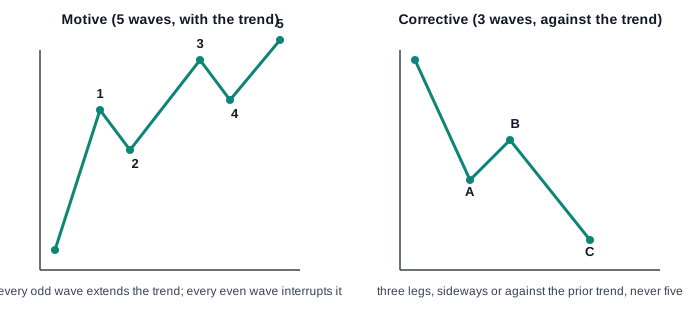
A motive wave subdivides into five smaller waves and travels net in the direction of the larger trend it's part of. Three of those five sub-waves (1, 3 and 5) point with the trend; two of them (2 and 4) interrupt it briefly before the trend resumes. The net effect, zoomed out, is unmistakably directional — which is exactly the point. A motive wave's job, structurally, is to make progress.
Corrective: three waves, against the trend
A corrective wave subdivides into three smaller waves (commonly labeled A, B, C) and travels net *against* the larger trend, or sideways relative to it. Where a motive wave makes progress, a corrective wave digests it — some combination of profit-taking, doubt, and repositioning that has to happen before the trend can extend further. Corrections come in more shapes than motive waves do (zigzags, flats, triangles — the subject of lesson 4), and that variety is itself diagnostic: motive structure is comparatively uniform because it's the crowd moving with conviction in one direction, while corrective structure is comparatively varied because it's the crowd disagreeing with itself about how much of the move to give back.
The count that matters is "how many," not "which way"
A beginner's instinct is to read wave counts as directional predictions — "five up" sounds like a call that price rises, "three down" sounds like a call that it falls. That's not quite the right frame. Motive and corrective structure can point in either direction: in a downtrend, the five-wave motive move points down, and the three-wave correction points up. What's constant across both cases is the *wave count*, not the direction. A five counts as motive whether it's rising or falling; a three counts as corrective whether it's rising or falling. Learning to separate "which structural role is this wave playing" from "which way is it going" is what lets a wave reader stay oriented on a chart in a downtrend as comfortably as one in an uptrend.
Why the distinction is load-bearing
This split matters practically because it tells you what to expect *next*, structurally, without pretending to know price levels in advance. A motive wave, once it completes, is followed by a correction of some kind, roughly proportional in scale — not because of a law of nature, but because a market that has just made concentrated directional progress typically needs to absorb some profit-taking and repositioning before the next motive wave can build the participation it needs. Conversely, once a correction completes, the odds favor a resumption of the larger trend in motive form, because the corrective phase's implicit job — digesting the prior advance — is what running to completion at all is signaling.
None of that is a guarantee, and it's worth restating plainly: expecting a correction after a motive move doesn't tell you when it starts, how deep it runs, or that it can't itself invalidate the count that anticipated it. What the motive/corrective distinction gives you is a *checkable expectation* — a specific structural shape to compare the next several swings against, so that a chart's actual behavior can either confirm the expectation or falsify it early, rather than leaving you evaluating a vague hunch about direction.
The label you should distrust the most
If a wave doesn't cleanly subdivide into five with the trend or three against it — if it's ambiguous, or forces an odd number of sub-waves that don't fit either pattern — that ambiguity is information, not a problem to paper over by picking whichever label looks more convenient. An honest wave reader treats "this doesn't clearly fit either category yet" as a legitimate, temporary state, and waits for more price action rather than forcing a premature label. Lesson 9 comes back to exactly this trap: the temptation to force a five where the market is actually giving you a three, or vice versa, usually to make the chart agree with a conclusion already reached.
What would invalidate this read
Structural mislabeling has a specific tell: a motive count that requires breaking one of the impulse rules covered in lesson 3 (wave 2 retracing past its own start, wave 4 overlapping wave 1's territory, wave 3 being the shortest of the three trending waves) is not a motive wave at all, whatever it looks like at a glance — it's more likely an unfolding correction wearing a five-wave costume. That single check — does the count in front of me actually satisfy the rules for the category I'm putting it in — is the first and cheapest invalidation test in this entire module, and it's worth running before any of the more detailed analysis in the lessons ahead.
Comments (0)
- No comments yet.