Wave counting workflow: top-down
The preceding lessons gave you the pieces — motive versus corrective, the impulse rules, the corrective shapes, degree, Fibonacci tendencies, invalidation. This lesson assembles them into an order of operations, because the sequence you check things in changes how reliable the result is, even when every individual check is correct. Working the wrong direction is one of the most common reasons two reasonable wave readers looking at the same chart end up with contradictory counts.
Start big, and only then get small
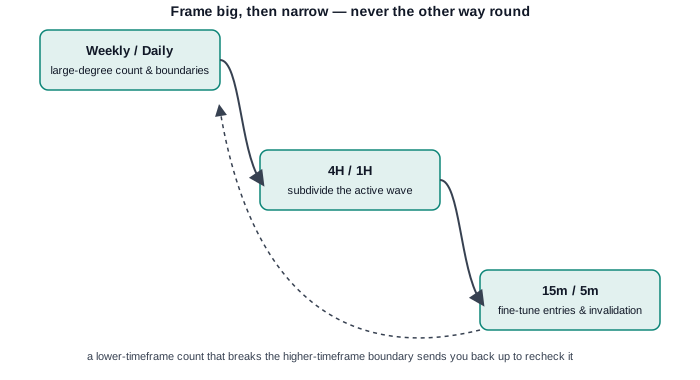
The workflow starts on the highest timeframe relevant to the question at hand — weekly or daily for a swing-oriented read — and asks the broadest structural question first: is this larger degree currently in a motive phase or a corrective phase, and what are the boundaries (the invalidation levels from lesson 7) that would tell you if that broad read is wrong? Only once that large-degree frame is reasonably settled does the analysis move down a timeframe, to identify which of the large-degree wave's sub-waves is currently active and subdivide *that* one — never the other way around.
Why bottom-up goes wrong
Starting from the smallest timeframe is tempting because that's where the freshest candles are, and freshest can feel like most relevant. But small-degree price action is also the noisiest, most overlapping, most ambiguous layer available — exactly the layer where a count is likeliest to be misread — and a count built there has no larger structure yet to check itself against. Two analysts starting from a 15-minute chart with no established higher-timeframe frame will often produce two different, equally defensible-looking counts, because there's nothing external constraining either of them. Establishing the large-degree frame first removes most of that ambiguity before it has a chance to compound: once you know the higher timeframe is in what looks like wave 3 of an impulse, the smaller-timeframe question narrows from "what is this chart doing" to the much more tractable "does this look like a coherent five-wave subdivision of a wave 3," per the degree-nesting check from lesson 5.
The step that's easy to skip, and shouldn't be
At every timeframe in the sequence, before moving down a level, the workflow requires stating that level's invalidation — the specific price or condition that would mean the current frame's read is wrong (lesson 7). This is the step most likely to get skipped under time pressure, because it doesn't feel like it advances the analysis. It's also the step that keeps the whole workflow honest: without it, "start big, get small" degrades into just anchoring on whatever large-degree story you liked first and fitting every subsequent, smaller timeframe to match it.
The feedback loop back up
The workflow isn't strictly one-directional. If a lower-timeframe count runs into a rule violation, or breaks a boundary the higher-timeframe frame depended on, that's a signal to go back up and recheck the larger read — not to force the small-degree count into agreement by relabeling it until it stops complaining. This feedback path, shown as the dashed arrow in the diagram, is what keeps a multi-timeframe read internally consistent: the larger frame constrains the smaller one going down, and a genuine contradiction at the smaller scale is allowed to send you back to reexamine the larger one.
What this looks like end to end
In practice, a full pass looks like: settle the daily-degree structural read and its invalidation; move to the 4-hour chart and identify which daily sub-wave is active, checking that it subdivides the way lesson 3 or lesson 4 says it should; move to a still-smaller timeframe only for the specific, narrower job of refining entry-relevant levels and a tighter invalidation, without re-deciding the large-degree question that's already settled. Each step down narrows the question being asked; none of the steps replace the ones before it.
What would invalidate this read
The workflow itself is testable the same way any single count is: if a large-degree frame, once established, keeps requiring revision every time a smaller timeframe is checked against it, that's a sign the large-degree read was too weakly supported to have been called "settled" in the first place — the fix is to spend more time and more evidence establishing the top of the sequence, not to abandon the top-down order and revert to whichever timeframe currently feels most legible. A workflow that gets overridden by convenience every time it's inconvenient isn't really a workflow, and this module's entire premise is that a disciplined order of operations produces a more checkable, more honest count than starting wherever feels easiest.
Comments (0)
- No comments yet.