Degree and nesting
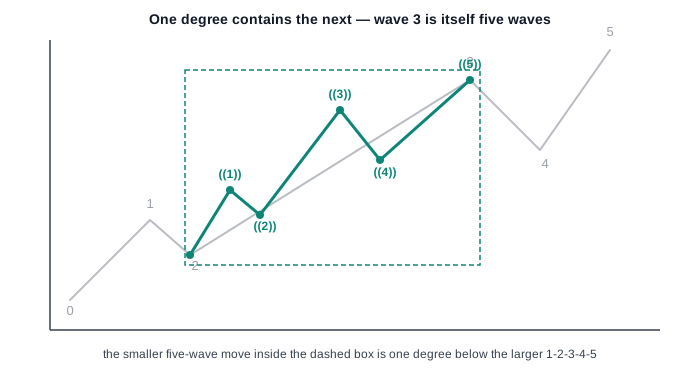
Every wave you've seen labeled so far in this module — 1 through 5, A through C — exists at some scale. Zoom in on wave 3 of an impulse and you'll typically find it subdivides into its own five smaller waves. Zoom in on any of those and, more often than not, you'll find another layer of subdivision underneath. Zoom out from the original impulse and you'll usually find it's itself one leg of a still-larger wave. This nesting — waves inside waves inside waves, the same handful of shapes repeating at every scale — is what wave analysts mean by "degree," and understanding it is what keeps a wave count coherent across timeframes instead of collapsing into a pile of contradictory labels.
Degree is relative, not absolute
A common early confusion is trying to figure out which degree a wave "really" is, as if degree were an intrinsic property like a wave's length in bars. It isn't. Degree is a relative statement about scale — this wave is one degree larger than that one, this one is one degree smaller than the wave it's part of. The same swing on a chart can correctly be called "wave 3" at one degree and, a layer down, "wave 1 of that wave 3" at the next degree smaller. Both labels are simultaneously true; they're just describing the same price action from two different zoom levels. Wave analysts historically named a ladder of degree labels running from very large (multi-year or longer) down to very small (intraday), but the names matter far less than the relationship: each degree is made of five or three waves of the next degree down, and is itself part of a wave one degree up.
Why this fractal quality isn't just a visual curiosity
The practical payoff of thinking in degrees is that it tells you where to look for confirmation or contradiction of a count. If you've labeled a move as wave 3 of an impulse, that claim makes a specific, checkable prediction about the timeframe one notch down: you should be able to find a coherent five-wave subdivision inside it, obeying the same rules from lesson 3, at the smaller degree. If you zoom in and the price action inside your proposed wave 3 doesn't organize into anything that looks like a clean five — if it looks more like a three, or an incoherent mess — that's a warning sign about the larger label, not just a shrug-worthy detail. Degree consistency is one of the more powerful cross-checks available, precisely because it forces a count to be right at more than one scale simultaneously rather than just the scale you happened to be looking at when you made the call.
Nesting and the top-down instinct
Because structure repeats at every scale, there's a strong temptation to count from the smallest, most recently printed candles upward — after all, that's the freshest information. This tends to produce brittle, frequently-revised counts, because small-degree price action is noisier and more ambiguous than large-degree price action, and a count built bottom-up has nothing larger to check itself against. The more reliable habit, developed fully in lesson 8, is to establish the larger-degree count first — where the structure is clearer and the boundaries more established — and use it to constrain which smaller-degree counts are even plausible. Degree, in that sense, isn't just a description of scale; it's a discipline for sequencing the analysis itself.
A word on how many degrees to track
There's no rule requiring a wave reader to label every degree simultaneously, and trying to do so on a single chart usually produces clutter rather than clarity. In practice, a useful read usually keeps two degrees in view at once — the degree that frames the current trade context, and the one degree smaller that's actively subdividing it — rather than attempting to hold five or six layers of labels in mind at the same time. Add a layer only when it earns its place by resolving an ambiguity the current view can't settle on its own.
What would invalidate this read
A degree-based read fails a specific, useful test: if the smaller-degree subdivision you expect to find inside a labeled wave simply isn't there — if wave 3 zoomed in doesn't produce anything resembling a coherent five, or a corrective wave zoomed in doesn't produce anything resembling a coherent three — the larger label is suspect, independent of whatever else looked fine about it. That cross-scale check is a second, complementary line of invalidation to the price-level checks in lesson 3 and lesson 7: a count can satisfy every price rule at its own degree and still be wrong, if the structure one degree down refuses to cooperate with it.
Comments (0)
- No comments yet.