The five-wave impulse and its rules
The impulse is the cleanest, most common form a motive wave takes, and it's the shape most of this module's counting logic is built around. Five sub-waves — 1, 2, 3, 4, 5 — with 1, 3 and 5 pushing the trend forward and 2 and 4 pausing it. What makes the impulse useful rather than just descriptive is that it comes with hard rules: structural constraints that a genuine impulse cannot violate. That's what separates wave counting from pattern-matching by eye — a candidate five-wave move either satisfies the rules or it isn't an impulse, full stop, no matter how much it resembles one visually.
The three rules
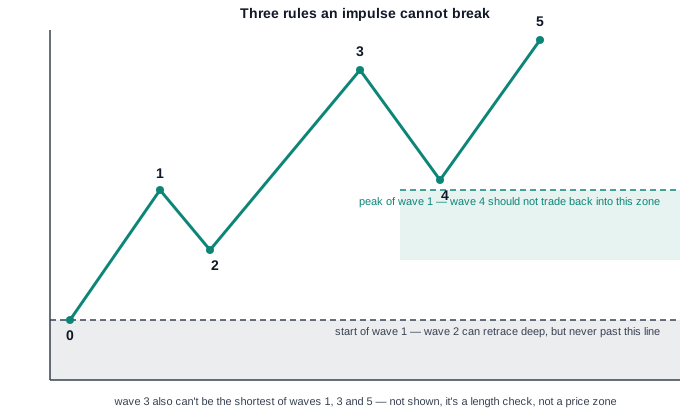
Wave 2 never retraces beyond the start of wave 1. If the pullback after wave 1 pushes price back past the level where wave 1 began, the move isn't a wave 2 of an impulse — the entire premise that price is in an early motive advance is already broken, and whatever happened needs a different label.
Wave 4 never enters wave 1's price territory. In a standard impulse, wave 4's low (in an uptrend) must stay above wave 1's high; wave 3's advance has to create clean separation that wave 4 doesn't erase. This is the rule beginners bump into most often, because a shallow-looking wave 4 that just barely dips into wave 1's range feels like it "should" still count — it doesn't. (A specific, less common impulse variant called a diagonal relaxes this rule; it's a named exception, not a loophole to reach for whenever wave 4 runs deep.)
Wave 3 is never the shortest of waves 1, 3 and 5. It doesn't have to be the longest — wave 5 sometimes extends further — but wave 3 giving up the "longest or tied" spot to both of the others isn't consistent with an impulse. This rule is a length comparison, not a price zone, so there's nothing to draw on a chart for it; it just has to be checked.
Rules versus guidelines
It's worth being precise about the difference between a rule and a guideline, because the two get treated very differently in a disciplined count. A rule is binary and non-negotiable — break it, and the label is wrong, not just unusual. A guideline is a strong tendency that shows up often enough to be useful, but that a valid impulse can still depart from without becoming invalid. Wave 2 and wave 4 tending to alternate in character (a sharp wave 2 paired with a sideways wave 4, or vice versa) is a guideline. Fibonacci proportions between waves, covered in lesson 6, are guidelines too. Confusing a guideline for a rule makes a wave reader too quick to throw out a perfectly valid count because one proportion looked slightly off; confusing a rule for a guideline makes a wave reader too willing to keep a broken count alive out of attachment to it. Both mistakes come from the same place — not tracking which category a given check belongs to.
Extensions
One of the five sub-waves, most often wave 3, sometimes extends into a much longer, more developed move that itself clearly subdivides into five smaller waves of its own degree. This is normal, not a violation of anything — an extension is still one wave of the larger five, it's just the one where the trend's underlying conviction shows up most visibly. Recognizing an extension in progress matters because it changes what you should expect from the wave that follows it: an extended wave 3 often leads into a comparatively brief, weaker wave 5, since much of the move's total energy has already been spent.
Why hard rules are the point, not a limitation
A count that can bend any rule to fit whatever price does next isn't a count — it's a rationalization applied after the fact. The value of having three specific, checkable rules is that they give a wave reader (and CAT's own wave-reading logic) a fast, objective way to reject candidate counts before spending any more time on them. Most raw five-wave-looking price shapes on a chart fail at least one of the three rules the moment you check carefully, which is a feature: it prunes the space of plausible counts down to the ones actually worth taking seriously.
What would invalidate this read
For an impulse specifically, invalidation is built into the rules themselves rather than being a separate concept bolted on afterward. If price closes back below the start of wave 1 while a wave 2 is in progress, the "impulse in progress" read is dead. If price trades deep into wave 1's territory during what was labeled wave 4, that count is dead too, and the chart needs relabeling — possibly as a correction wearing five waves' clothing, the exact trap lesson 9 details. That's the sense in which the rules aren't restrictions on wave counting; they're the mechanism that makes wave counting falsifiable at all, and falsifiable is what makes it worth doing.
Comments (0)
- No comments yet.